
AI (Artificial Intelligence)
Artificial Intelligence (AI) is the collective term for technologies that enable computers to perform tasks that normally require human intelligence. These include analysing data, recognising patterns, understanding language, making predictions, generating content and supporting or automating decision-making.
Modern AI systems learn from data using machine learning techniques. Rather than following only explicitly programmed instructions, they improve their performance by identifying patterns in large datasets. Deep learning, a specialised branch of machine learning based on artificial neural networks, has enabled major advances in areas such as computer vision, speech recognition and natural language processing.
The term Artificial Intelligence was coined in 1956 during the Dartmouth Conference in the United States by computer scientist John McCarthy. Researchers believed that human intelligence could be simulated by machines, although practical progress proved far more difficult than initially expected.
- 1980s–1990s
Expert systems and the first practical machine learning techniques emerged. - 2000s
The rapid growth of the internet and digitalisation generated enormous amounts of data, creating the foundation for modern AI. - 2010s
Breakthroughs in deep learning, combined with powerful GPUs, enabled major advances in image recognition, speech recognition and language processing. - Since 2020
Large Language Models (LLMs), such as GPT, Claude and Gemini, together with generative AI, have made advanced AI capabilities widely accessible to businesses and consumers.
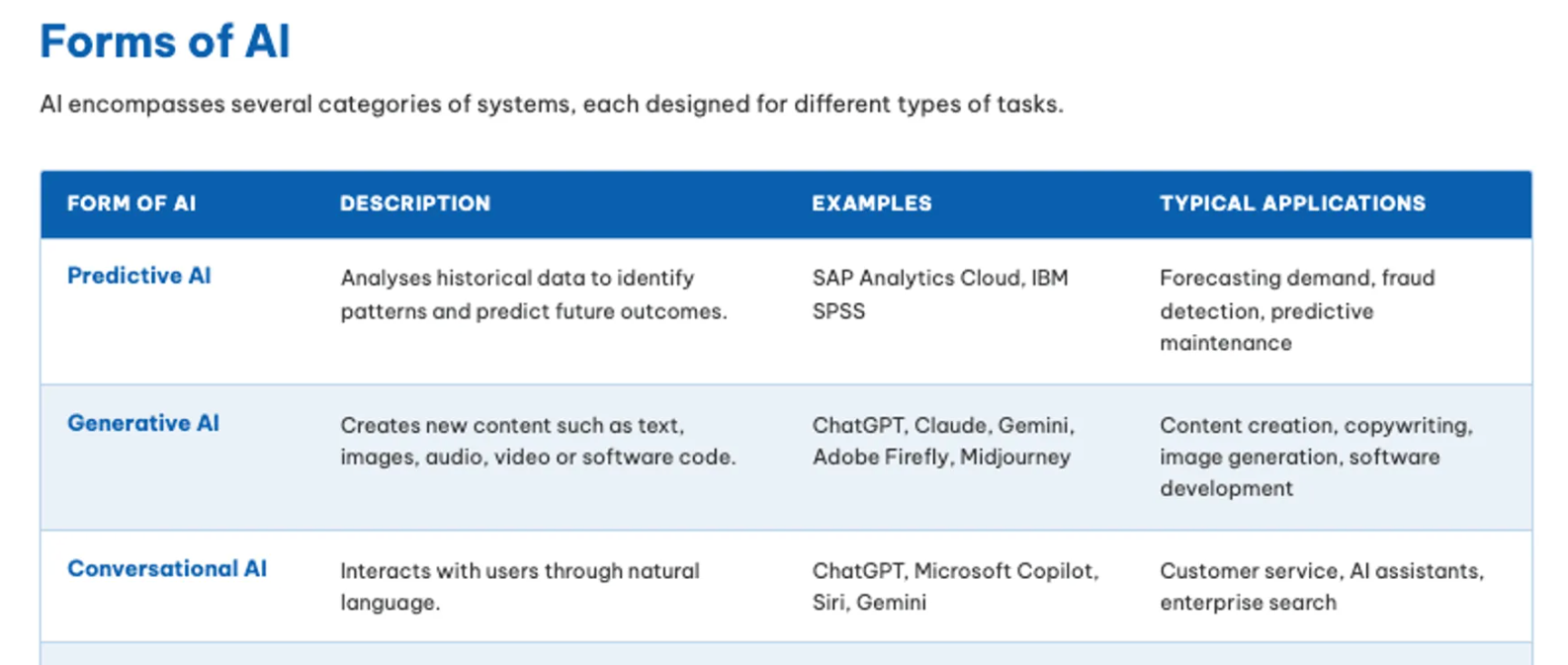
Forms of AI
AI takes different forms, depending on the purpose for which it is used. Some applications are predictive, others advisory or creative, and yet others take fully autonomous decisions.
Examples of AI in practice
Netflix recommendations
Netflix continuously analyses the viewing behaviour of millions of users to provide increasingly accurate and personalised recommendations.
Autonomous vehicles
Self-driving vehicles analyse information from cameras, sensors and radar systems in real time. AI recognises traffic situations, predicts the behaviour of other road users and supports or performs driving decisions such as braking, steering and lane changes.
AI in Media: Opportunities and Challenges
Artificial intelligence is transforming the media industry. It supports journalists, publishers, broadcasters and advertisers by helping to create content, personalise user experiences, optimise advertising campaigns, analyse audiences, automate translations and subtitles, and improve media planning.
At the same time, AI raises important questions about transparency, copyright, bias, misinformation and editorial responsibility. As AI becomes more deeply integrated into media workflows, maintaining human oversight and public trust remains essential.


